Pentacubes in an Odd Box

Introduction

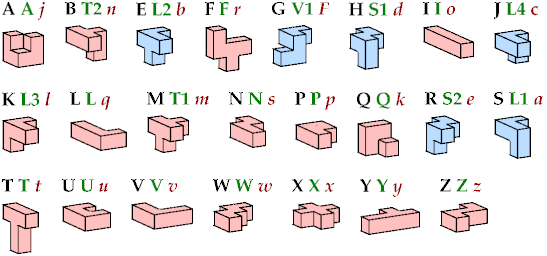
A pentacube is a solid made of five equal cubes joined face to face. There are 23 such figures, not distinguishing reflections and rotations:

The six blue tiles have distinct mirror images. Kate Jones's systematic names are shown in green. Donald Knuth's names are shown in red. In all three nomenclatures, pentacubes that lie all in one plane are named for the corresponding pentominoes. (Kate Jones uses Solomon Golomb's names; Donald Knuth uses John Conway's names.)

Can a rectangular prism, or box, with odd volume, be filled with copies of a pentacube? For each pentacube, here is the smallest known odd box that it can fill. Torsten Sillke's polycube box tiling page identifies many boxes besides the smallest that can be tiled by polycubes. Toshihiro Shirakawa's Box Packing Collection has extensive box tiling data for polycubes, edge-polycubes, and polyhypercubes.

Pentacube A is unsolved.

Pentacubes G, M, and X cannot tile an odd box. See below for hybrid solutions.

The minimal odd box for pentacube R was reported by Mike Reid. As far as I know, he did not publish his tiling.

See also

  • Pentacubes in a Box
  • Pentacube Pair Odd Boxes
  • Solutions

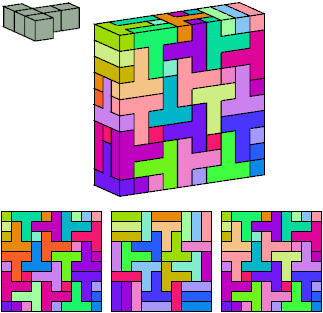
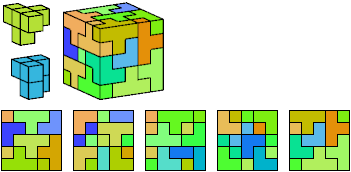
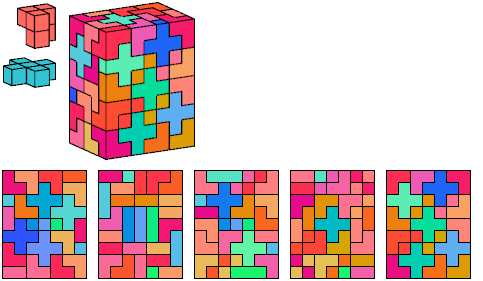
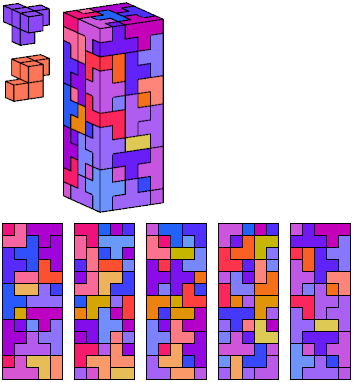
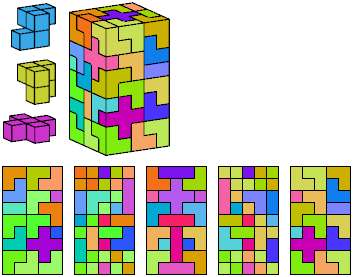
    Cross-sections are shown from back to front.

    A

    No solution known.

    B

    351 tiles, 3×13×15

    Johan van de Konijnenberg

    E

    25 tiles, 5×5×5

    Torsten Sillke

    Allowing Reflection

    15 tiles, 3×5×5

    Torsten Sillke

    F

    55 tiles, 5×5×11

    Torsten Sillke

    G

    Impossible even with reflection

    See below for hybrid solutions.

    H

    45 tiles, 5×5×9

    Torsten Sillke

    Allowing Reflection

    No smaller solution is known if the pentacube may be reflected.

    I

    1 tile, 1×1×5

    J

    15 tiles, 3×5×5

    Torsten Sillke

    Allowing Reflection

    9 tiles, 3×3×5

    Torsten Sillke

    K

    27 tiles, 3×5×9

    Torsten Sillke

    L

    15 tiles, 3×5×5

    Torsten Sillke

    M

    No solution.

    The M pentacube has a color imbalance of 3. Therefore any odd number of M pentacubes has an imbalance that is a multiple of 3. But an odd box has a color imbalance of 1.

    See below for hybrid solutions.

    N

    25 tiles, 5×5×5

    Helmut Postl

    P

    9 tiles, 3×3×5

    Torsten Sillke

    Q

    45 tiles, 5×5×9

    Torsten Sillke

    R

    133 tiles, 5×7×19

    Mike Reid

    Allowing Reflection

    45 tiles, 5×5×9

    Toshihiro Shirakawa (白川俊博)

    S

    135 tiles, 5×9×15

    Toshihiro Shirakawa (白川俊博)

    Allowing Reflection

    27 tiles, 3×5×9

    Toshihiro Shirakawa (白川俊博)

    T

    153 tiles, 3×15×17

    Johan van de Konijnenberg

    U

    21 tiles, 3×5×7

    Torsten Sillke

    V

    45 tiles, 5×5×9

    Torsten Sillke

    W

    63 tiles, 5×7×9

    Toshihiro Shirakawa (白川俊博)

    X

    No solution.

    The X pentacube cannot tile even a corner of a box, much less a whole box.

    See below for hybrid solutions.

    Y

    25 tiles, 5×5×5

    C. J. Bouwkamp

    Z

    135 tiles, 5×9×15

    Toshihiro Shirakawa (白川俊博)

    Hybrid Solutions

    Pentacube A has no known solution, and G, M, and X cannot tile an odd box by themselves. Some pairs of these tiles can jointly tile an odd box.

    A + G

    No solution known.

    A + M

    25 tiles, 5×5×5

    A + X

    65 tiles, 5×5×13

    G + M

    65 tiles, 5×5×13

    G + X

    No solution known.

    M + X

    No solution. Pentacubes M and X each has a color imbalance of 3. An odd box has a color imbalance of 1.

    A + G + X

    45 tiles, 5×5×9

    Last revised 2026-03-08.


    Back to Polycube Tiling < Polyform Tiling < Polyform Curiosities
    Col. George Sicherman [ HOME | MAIL ]